- Hygiene
Facts and Figures about Hygiene
Tobias Gebhardt
Chief Executive Officer
Hospital-acquired infections are a burden for patients, their families, and hospital staff. Various publications have released data on this topic. A selection of that data is visualized in the following infographic.
In addition to the fact that hospital infections should definitely be avoided for ethical reasons, it is also evident that so-called nosocomial infections represent a financial burden for hospitals.
The guiding principle is: "Prevention is cheaper than reaction."
A useful comparison can be drawn with a lightning rod: installing a lightning rod on a building costs money. However, if you choose not to install one and lightning strikes, restoring the building to its original state is significantly more expensive than the cost of the lightning rod. This analogy can be applied to infection prevention.
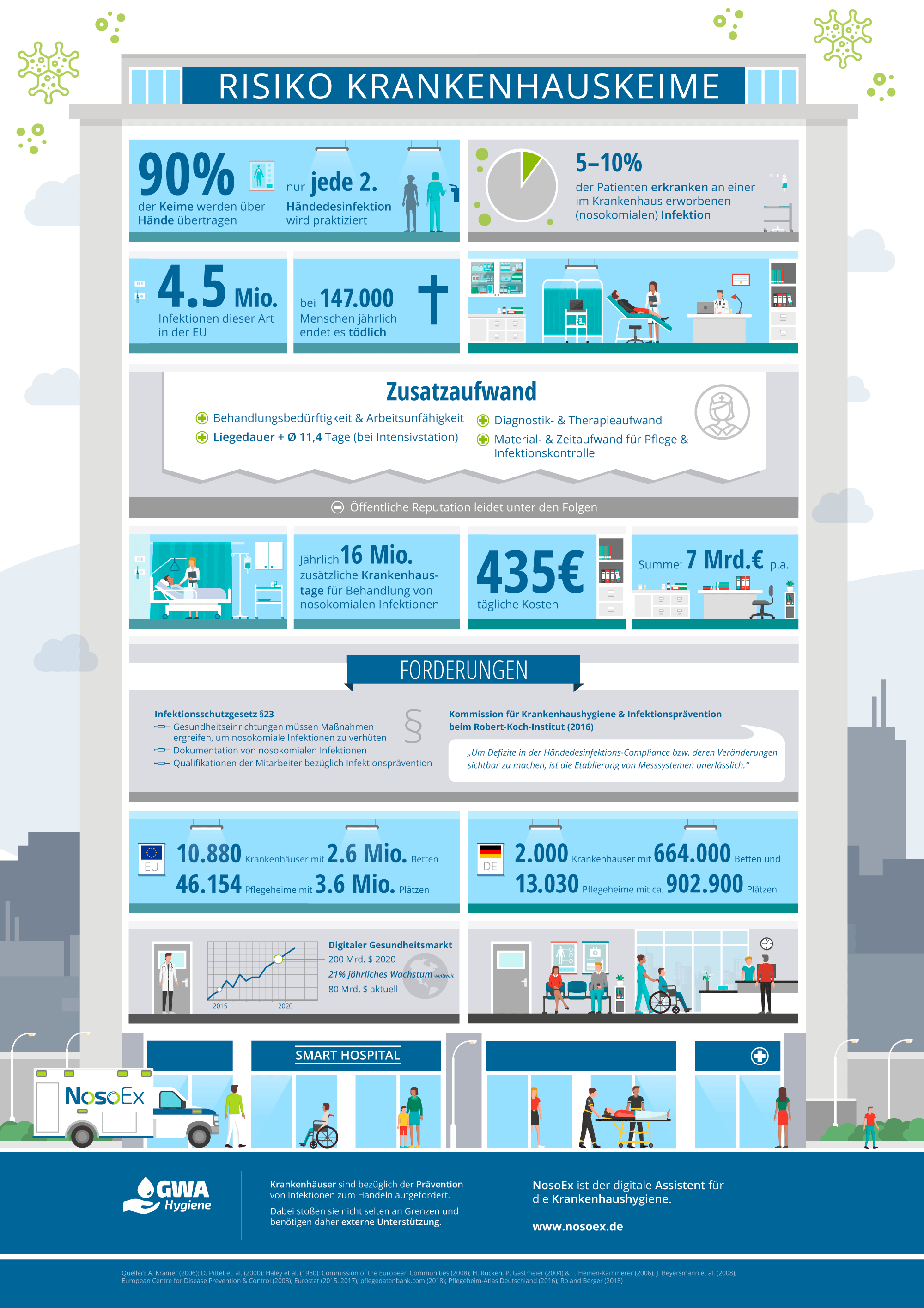
🏥 RISK OF HOSPITAL GERMS
🔹 90% of germs are transmitted via hands
🔹 Only every 2nd hand disinfection is actually performed
🔹 5–10% of patients acquire a hospital-acquired (nosocomial) infection
📊 Infections in the EU
- 4.5 million such infections annually
- Around 147,000 deaths each year
⚠️ ADDITIONAL BURDENS
- Need for treatment & inability to work
- Extended hospital stays:
→ +11.4 days (in intensive care) - Diagnostic & therapeutic effort
- Material & time for care & infection control
✅ Public reputation also suffers
💰 Economic Impact
- 16 million additional hospital days annually
- €435 daily cost per patient
- Total: €7 billion per year
📌 DEMANDS
🇩🇪 Infection Protection Act §23
- Healthcare facilities must take preventive measures
- Documentation of nosocomial infections
- Staff qualification in infection prevention
🏛️ Commission for Hospital Hygiene & Infection Prevention
(Robert Koch Institute, 2016)
“To make deficits in hand disinfection compliance visible and derive improvements, the introduction of measurement systems is essential.”
🏨 Infrastructure in the EU
- 10,880 hospitals
- 2.6 million beds
- 46,154 nursing homes
- 3.6 million places
🏥 Infrastructure in Germany
- 2,000 hospitals
- 664,000 beds
- 13,030 nursing homes
- 902,900 places
📈 Digital Health Market
- From 2004 to 2020
- +27% average annual growth
- Market volume: €80 billion (2020 estimate)
🏥 SMART HOSPITAL
Hospitals are urged to act on infection prevention.
This includes identifying and understanding risks, and receiving appropriate support.
🤖 NosocoEx
Your digital assistant for hospital hygiene
🔗 www.nosoex.de